Texture Standardization for Export Halal Meat: How Plants Reduce Batch Variation
Export customers judge halal meat on more than certification status. They expect repeatable bite, sliceability, cook performance, yield, and appearance across shipments. For QA managers, texture variation becomes a commercial risk: one batch passes sensory review, another feels dry, tough, or inconsistent after freezing, thawing, marination, or further processing.
Amanah Catalytics supports meat processors that need a halal enzyme supplier for meat processing with documentation-ready inputs, practical trial guidance, and a controlled approach to texture development.
The goal is not to make meat artificially soft. The goal is to help the plant tighten variation so export specifications are easier to defend.
Why texture variation appears in export halal meat programs
Even disciplined plants see natural variation. Raw material source, animal age, muscle type, pH, chilling profile, freeze-thaw history, cut size, tumbler loading, brine distribution, and thermal processing all influence final texture.
For export halal operations, the pressure is higher because product may travel farther, spend longer in cold chain storage, and face customer verification at destination.
Common QA concerns include:
- Toughness variation between cartons from the same production day
- Uneven marinade uptake or inconsistent purge after thawing
- Poor slice integrity in cooked or reformed products
- Customer complaints on bite, chew, or dryness
- Rework caused by batches outside agreed texture range
- Difficulty linking deviation to one processing variable
Enzyme processing can help, but only when it is treated as a controlled processing aid within a documented production system.
The role of enzymes in texture standardization
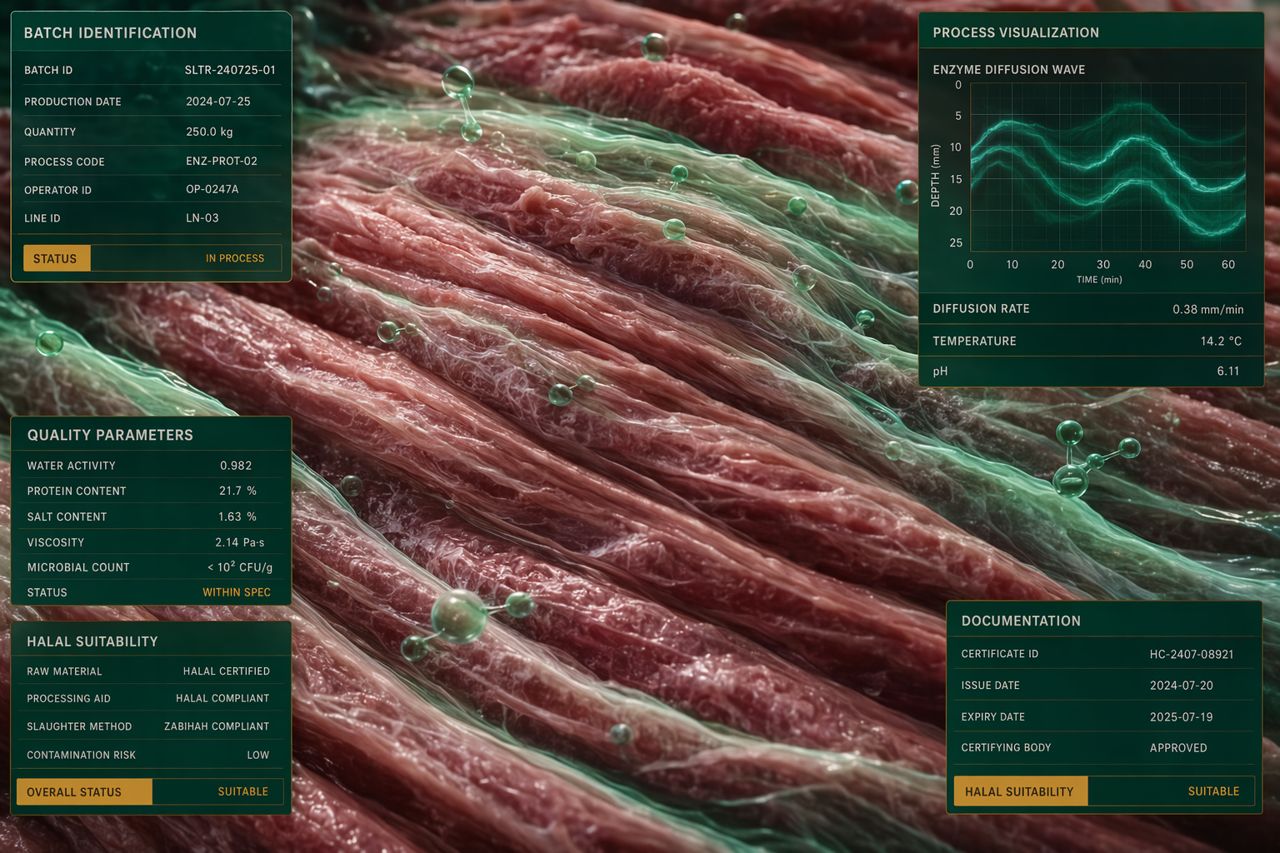
Selected proteolytic enzyme systems can influence protein structure under defined plant conditions. In meat processing, that influence must be managed carefully. Over-processing can damage bite, reduce slice integrity, or increase purge. Under-processing may deliver no measurable improvement.
A controlled enzyme program should define:
- Where the enzyme is added in the process
- How contact time is managed
- How temperature exposure is controlled
- How distribution is verified across the batch
- How the process is stopped, diluted, cooked, or otherwise stabilized
- What finished-product attributes are measured
This is why supplier selection matters. A commodity input with limited documentation is not enough for export halal production. QA needs a partner that understands plant trials, formulation records, halal suitability, and residue control expectations.
What QA managers should require from a halal enzyme supplier
A credible supplier should support both compliance review and plant execution. Before trial approval, QA and procurement teams should request a complete technical package.
Key requirements include:
- Halal suitability documentation for the enzyme product and relevant processing materials
- Ingredient declaration support aligned with the target market
- Allergen, GMO, origin, and carrier information where applicable
- Food safety and quality documentation for supplier approval
- Clear handling, storage, and shelf-life guidance
- Batch traceability and certificate availability
- Practical use guidance for the intended meat application
- Support during pilot and production-scale validation
Amanah Catalytics works with processors to organize this information before plant trials begin, so QA, halal assurance, R&D, and production are aligned.
Building a plant trial that reduces risk
Texture standardization should not start with a full production run. A staged trial gives the plant useful data without exposing customer orders to unnecessary risk.
1. Define the commercial texture target
Start with the export specification. Is the priority tenderness, sliceability, reduced chewiness, improved bite uniformity, better cook yield, or consistency after thawing? The target should be practical and measurable by the plant’s own QA system.
2. Select one variable to test at a time
Many trials fail because enzyme level, contact time, tumbling conditions, salt, phosphate, temperature, and cook schedule all change together. A focused trial isolates the enzyme process so the plant can see whether it creates useful improvement.
3. Compare against real production variation
The control should reflect standard plant practice, not an ideal laboratory condition. Export customers experience the real product, so the trial should compare against the plant’s normal batch variation.
4. Include hold and distribution checks
Texture depends on contact and distribution. In a halal meat plant, the enzyme program should fit existing batching, injection, tumbling, marination, or mixing steps without creating hidden variation inside the batch.
5. Confirm finished-product performance
Assessment should include the product condition customers actually receive: chilled, frozen, thawed, cooked, sliced, reheated, or packed. Export validation is strongest when the trial follows the product through the relevant cold chain and preparation steps.
Residue control and process discipline
Residue control is a frequent concern in enzyme-assisted meat processing. QA teams need confidence that the enzyme system is used as intended, controlled during production, and addressed within the finished-product process design.
A practical control plan may include:
- Approved formulation records
- Controlled addition points
- Defined mixing or contact procedures
- Time and temperature records
- Batch segregation during trials
- Finished-product checks against texture and purge targets
- Cleaning and changeover instructions where needed
The important point is discipline. Enzyme processing should be visible in the batch record, not treated as an informal production adjustment.
Where enzyme support can create value
For export halal meat processors, texture standardization can support several business outcomes:
- More consistent product acceptance across shipments
- Lower risk of customer claims related to toughness or dryness
- Better alignment between raw material variability and finished specification
- Improved confidence during new customer onboarding
- More predictable performance in marinated, cooked, sliced, or reformed products
- Stronger technical documentation for supplier audits
The value is not only formulation performance. It is also documentation readiness, batch traceability, and reliable technical support when QA needs answers.
Practical applications in halal meat plants
A controlled enzyme texture program may be considered for:
- Marinated beef, lamb, or poultry cuts
- Value-added export meat portions
- Cooked and sliced meat products
- Further-processed halal meat lines
- Products exposed to freezing, thawing, or extended distribution
- Batches where raw material variability affects final bite
Each application requires its own validation. Muscle structure, fat level, salt system, pH, thermal process, and packaging format all influence outcome.
Choosing a supplier for export-oriented programs
When evaluating a halal enzyme supplier for meat processing, QA should look beyond price per kilogram. The stronger question is whether the supplier can help the plant protect customer specifications.
Ask suppliers:
- Can you provide halal suitability documentation before trial approval?
- Can you support our internal supplier qualification file?
- Can you advise on plant-scale trial structure without disrupting production?
- Can you help define process controls that reduce over-processing risk?
- Can you provide consistent supply and batch traceability?
- Can your team respond quickly during export customer review?
Amanah Catalytics is built for these requirements: clear documentation, technical restraint, and plant-ready support for halal processors that need repeatability.
Request a quote for a controlled plant trial
If your plant is working to reduce texture variation in export halal meat, Amanah Catalytics can help you evaluate a suitable enzyme solution and build a documented trial plan.
Use the on-site request a quote form to share your product type, target market, process step, and texture challenge. Our team will respond with a practical recommendation for QA review and plant validation.