Label Control for Marinated and Restructured Halal Meat Products
For halal meat processors, label control is not only a packaging function. It is a QA discipline that connects formulation, supplier qualification, process validation, halal assurance, and finished-product release.
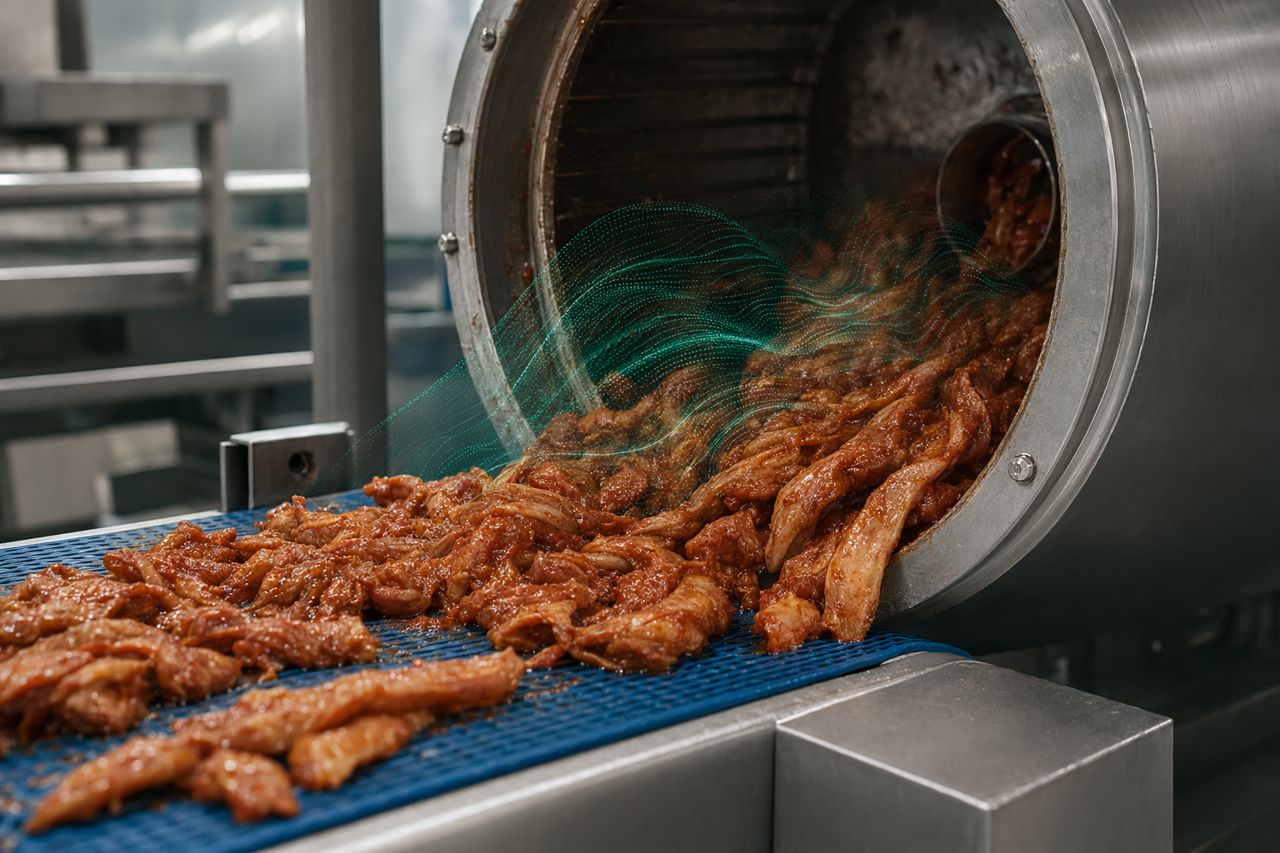
Marinated and restructured meat products create extra complexity because functional ingredients may be introduced through brines, marinades, tumbling systems, binding steps, forming lines, or surface treatments. When enzyme solutions are used to support texture, tenderness, slice integrity, or yield consistency, the processor needs a clear position on what the enzyme is, where it enters the process, what documentation supports halal suitability, and how the final label is controlled.
Amanah Catalytics supports halal meat processors with enzyme solutions designed for plant trials, documentation readiness, residue control, and reliable production transfer. For QA teams evaluating a halal enzyme supplier for meat processing, the right question is not simply whether an enzyme works. The question is whether it can be controlled.
Why label control becomes harder in marinated and restructured meat
Marinated and restructured products often involve multiple functional systems at once:
- Salt, phosphate alternatives, proteins, fibers, starches, hydrocolloids, and flavor systems
- Enzymes used to support tenderness, binding, texture modification, or process consistency
- Multi-stage mixing, injection, tumbling, forming, cooking, chilling, and slicing
- Private-label customer requirements with different ingredient declaration expectations
- Export-market halal documentation and finished-label review
This creates a practical risk: the production process may be technically acceptable, but the label file may not fully explain the role, source, halal status, or use conditions of every processing aid or functional ingredient.
For QA managers, the priority is to close that gap before commercial scale-up.
Start with classification: ingredient, processing aid, or formulation input
Enzyme use can be handled differently depending on product type, market, customer specification, and local regulation. A processor should not assume that one label approach applies everywhere.
A controlled label review should confirm:
-
The enzyme preparation identity
What is supplied, what carriers or stabilizers are included, and whether any support materials have declaration relevance.
-
The intended manufacturing role
Is the enzyme used for tenderization, binding support, texture control, process efficiency, or another function?
-
The point of addition
Brine, marinade, mixer, tumbler, forming step, surface application, or another defined process point.
-
The expected status in the finished product
Whether the enzyme remains functionally active, is controlled by heat or process conditions, or is managed as a processing aid under the applicable label framework.
-
Customer and jurisdiction requirements
Retail, foodservice, export, and private-label programs may apply different documentation expectations.
Amanah Catalytics helps technical teams build this information into the trial file early, so label review does not become a late-stage commercialization delay.
Halal suitability must be documented, not inferred
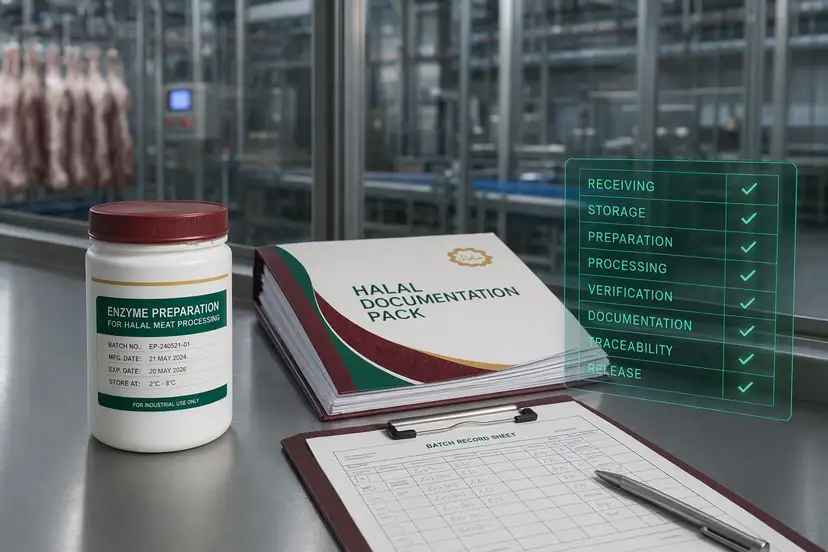
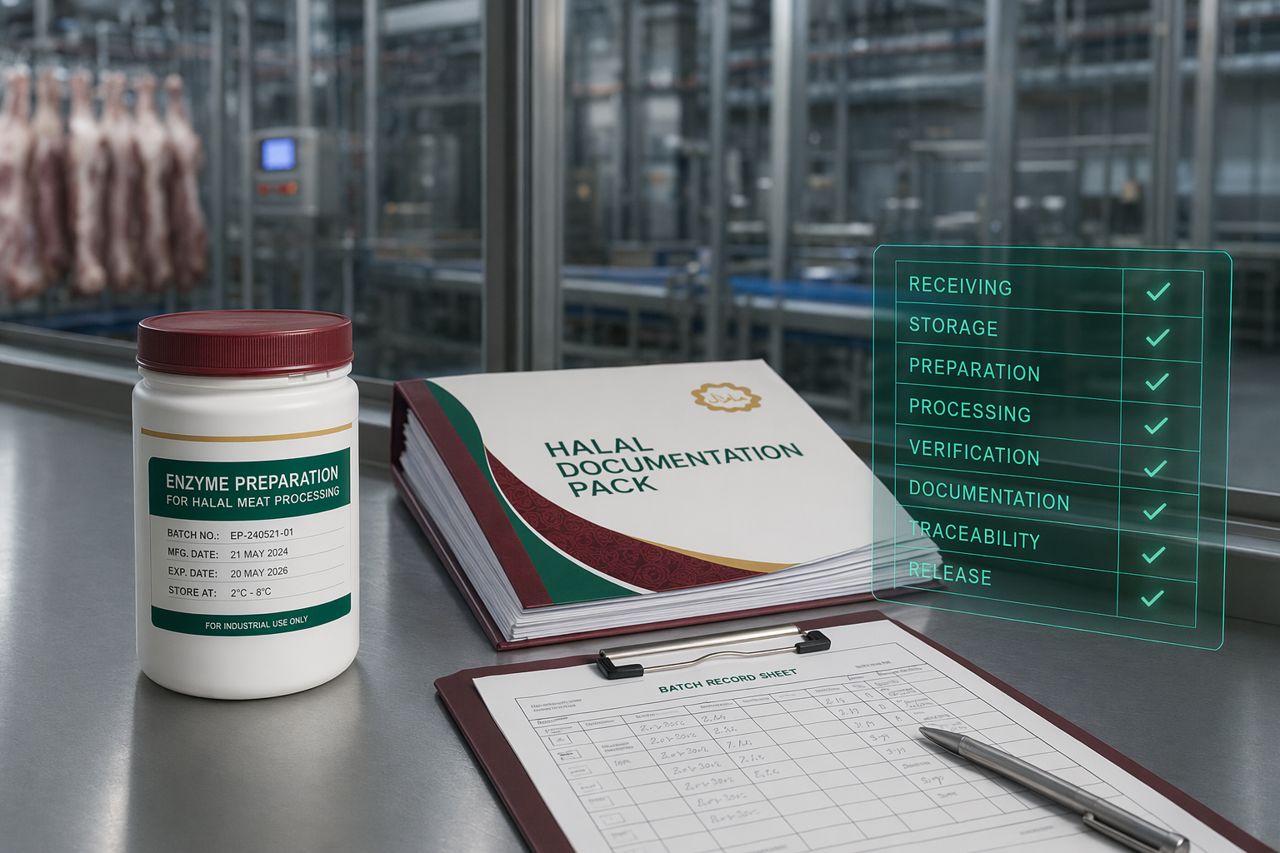
In halal meat processing, enzyme source and supply-chain integrity are central. QA teams should verify halal suitability through controlled supplier documents, not verbal assurances.
A complete enzyme review may include:
- Halal certificate or halal suitability statement
- Source and origin declaration for enzyme and support materials
- Animal-origin status where applicable
- Alcohol and solvent status where relevant to the preparation
- GMO-status statement if required by the customer or market
- Allergen statement
- Food-grade manufacturing declaration
- Country-of-origin and traceability documentation
- Change-notification commitment
- Batch-level certificate of analysis or conformity, where agreed
For marinated and restructured meat, the documentation package should be connected to the actual formula, process step, and label version. This prevents a common audit issue: having supplier documents on file but not linked clearly to the finished-product specification.
Residue control and process discipline
Enzyme systems are valuable because they can modify protein structure under controlled conditions. That same functionality requires discipline.
Processors should define:
- Addition point and dispersion method
- Contact time window
- Temperature exposure profile
- Mixing, tumbling, or holding conditions
- Heat step or process endpoint where relevant
- Cleaning and line-change procedures
- Segregation between halal-approved and non-approved materials
- Batch record fields that confirm controlled use
Residue control is not only a laboratory question. It is also a process-control question. If operators vary hold time, temperature, marinade concentration, or line scheduling, finished texture and label-risk assumptions may shift.
A practical supplier should help the plant convert enzyme performance into repeatable production instructions.
Restructured meat needs extra label discipline
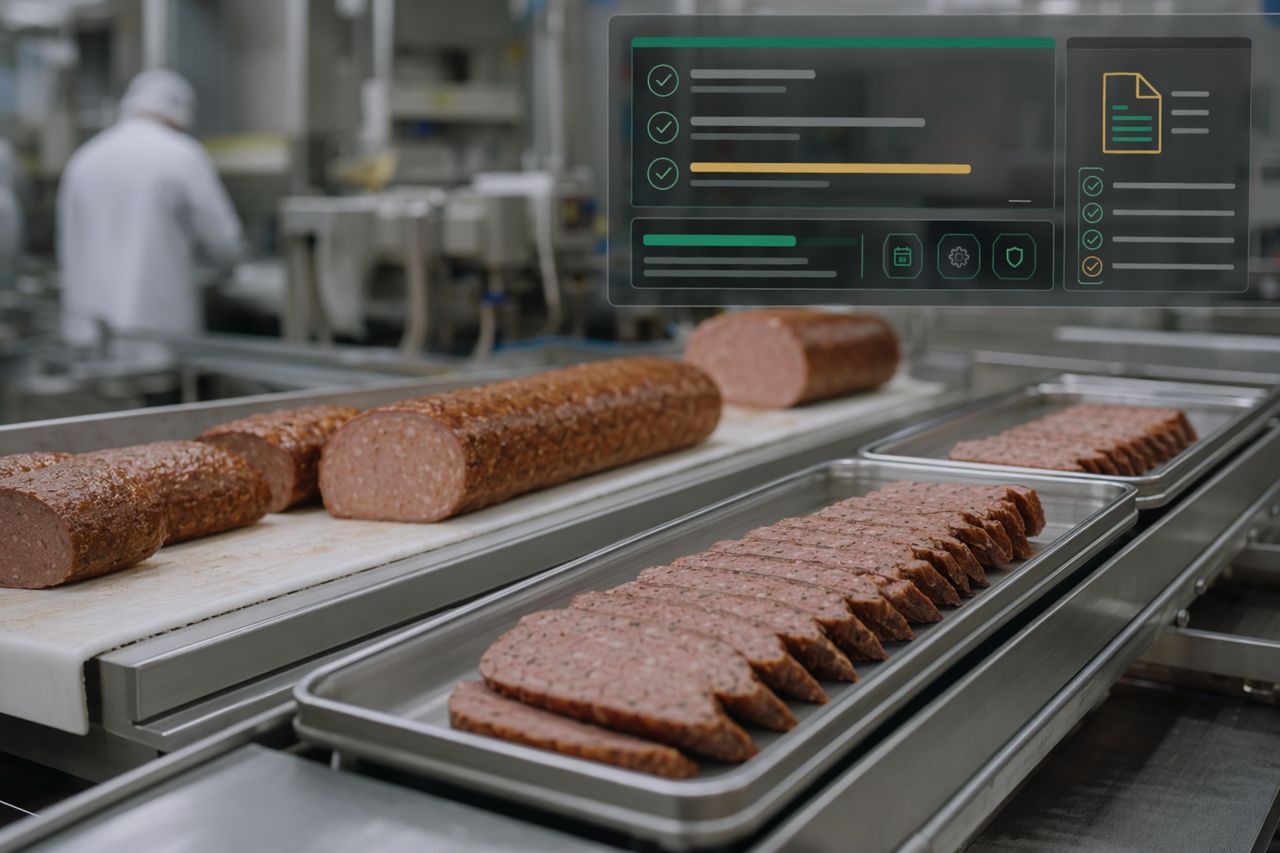
Restructured halal meat products may include formed steaks, portioned strips, kebab blocks, deli-style slices, pressed products, or value-added cooked formats. These products often rely on precise texture management and protein interaction.
Label-control concerns may include:
- Whether the product name accurately reflects the process and structure
- Whether binding, forming, or restructuring language is required by the customer or market
- Whether added water, marinade, or solution statements are needed
- Whether functional ingredients are declared consistently across artwork, specification, and ERP formula
- Whether halal claims align with the certifier’s scope and approved ingredient list
When enzymes are part of the process, QA should ensure that trial reports, process records, and final specifications use the same terminology. Inconsistent naming can create unnecessary questions during customer approval or halal audit review.
What QA should request from an enzyme supplier
A dependable halal enzyme supplier for meat processing should provide more than a sample.
Ask for:
- A clear product specification suitable for food manufacturing review
- Halal documentation aligned to the supplied material
- Declaration support for carriers, stabilizers, and processing aids
- Recommended process window for plant trials
- Compatibility notes for brines, marinades, proteins, salts, and heat steps
- Scale-up guidance for mixing and uniform distribution
- Change-control and batch traceability commitments
- Technical support during first production validation
The goal is not to transfer supplier language directly onto the label. The goal is to give QA, regulatory, halal assurance, and product development teams enough controlled information to make the right label decision.
Plant trials should produce label evidence, not just product samples
A successful trial is not only a tray of acceptable product. It should create a usable decision file.
For each enzyme-assisted trial, capture:
- Formula version and ingredient lot references
- Supplier documentation version used for approval
- Addition point and process conditions
- Hold, tumble, cook, chill, and slice observations where relevant
- Yield, purge, texture, and sensory comparisons
- Any deviation from the intended process window
- Finished-product label draft and declaration rationale
- Halal approval status and certifier comments, if applicable
This evidence allows the processor to defend the label position internally and externally.
Common label-control failures to avoid
1. Treating enzyme documentation as generic
A certificate may cover a product family, but QA still needs to confirm that it applies to the exact supplied grade and batch pathway.
2. Ignoring carriers and support materials
Even when the enzyme is the functional focus, other components in the preparation may affect allergen, halal, origin, or declaration review.
3. Changing process conditions after label approval
If the plant changes addition point, hold time, heat exposure, or formulation level, the label rationale may need review.
4. Separating halal approval from label approval
Halal suitability, regulatory classification, and customer label requirements should be reviewed together. Sequential review increases delay risk.
5. Scaling without operator controls
If plant operators do not have clear instructions, enzyme distribution and product consistency can vary. That can create both quality and compliance pressure.
Amanah Catalytics approach
Amanah Catalytics supplies enzyme solutions for halal meat processors with a compliance-minded support model:
- Documentation-ready supply packages
- Halal suitability review support
- Practical plant-trial guidance
- Process-window recommendations for consistent use
- Residue-control and process-endpoint discussion
- Supplier reliability for production continuity
- Technical communication suitable for QA, R&D, procurement, and halal assurance teams
We work with processors who need enzyme performance without creating unnecessary label uncertainty.
Practical checklist for QA teams
Before approving an enzyme-assisted marinated or restructured halal meat product, confirm:
- The enzyme preparation is approved in the ingredient master file
- Halal documentation is current and linked to the exact supplied material
- Carriers and support materials have been reviewed
- The intended process role is documented
- The label position has been reviewed for the target market
- The plant trial reflects the commercial process
- Residue-control assumptions are supported by process conditions
- Batch records include the right control fields
- Procurement understands approved supplier and substitution limits
- Change-notification requirements are documented
Build label confidence before scale-up
Label control is strongest when it is designed into the enzyme evaluation from the first technical discussion. That is especially important for marinated and restructured halal meat products, where formulation, process control, halal assurance, and customer label review intersect.
If your team is evaluating an enzyme system for tenderness, binding, texture control, or yield consistency, Amanah Catalytics can support a controlled review and plant-ready trial plan.
Request a quote through the on-site form to discuss your product type, process step, halal documentation needs, and trial objectives.